On Tuesday’s AOA, we begin the show by checking markets with DuWayne Bosse from Bolt Marketing in Segment One. In Segment Two, we look at the third quarter results of the Federal Reserve Bank of Minneapolis Ag Credit Survey with Joe Mahon, Director of Regional Outreach for the Federal Reserve Bank of Minneapolis. In Segment Three, we discuss the current state of prices at the meat counter, meat exports and more with PMI Foods President and CEO Darin Parker. Then in Segment Four, Jesús Soto, Animal Health Technician for USDA Veterinary Services, joins us to
Author: Eric Sherred
PMI Foods Donates 800 Pounds of Beef to LA’s Dream Center Veterans Day Cookout
Food & Beverage Magazine
by Michael Politz
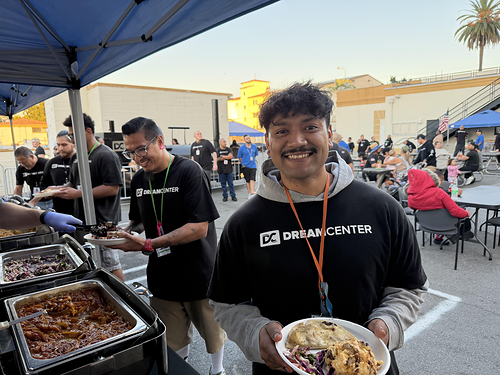
On Veterans Day, saying “thank you for your service” meant something you could put on a plate. In Los Angeles, hundreds of veterans and their families gathered for a cookout fueled by 800 pounds of top sirloin and rib eye steaks — a donation that turned gratitude into a hot meal for people who too often go without one.
The protein came from Parker Migliorini International (PMI Foods), a leading global food distributor, in support of The Dream Center‘s Veterans Day cookout. The event served military veterans, families, and people experiencing homelessness across the Los Angeles area — populations that continue to feel the squeeze of food insecurity.
A Steady Commitment, Not a One-Off
This latest contribution is part of a larger pattern. The 800-pound donation pushes PMI Foods past 7,600 pounds of beef given to organizations serving food-insecure communities in the Los Angeles area since 2025.
The partnership between PMI Foods and The Dream Center didn’t start at a cookout. It grew out of wildfire relief and food assistance for families affected by the 2025 SNAP disruptions — and continued through PMI Foods’ ongoing work with The Dream Center and CityServe International.
“Veterans Day is a chance to pause and say thank you to those who have served, and to ensure they feel the support of their community,” said PMI Foods President Darin Parker. “The Dream Center and their partners are a great example of what it looks like to show up for our neighbors. We are proud to keep working alongside them and serve those who have so bravely served all of us.”
For The Dream Center, the donation was the difference between serving its community and falling short of growing demand.
“We would not have been able to serve the hundreds of veterans and their families who we were able to support without the generous protein donation from PMI Foods,” said Donny Irmen, director of the Los Angeles Dream Center. “We have seen a significant increase in families facing hardships in their communities and are grateful for the opportunity to spread God’s grace through supporting our veterans.”
Who The Dream Center Serves
Founded in 1994, The Dream Center has grown from a neighborhood effort into one of Los Angeles’ most trusted sources of hope, offering food distribution, outreach programs, and support services. Its reach extends to a diverse range of neighbors, including:
- Families supported by the Department of Children and Family Services (DCFS)
- Veterans and individuals in recovery living in transitional housing
- Survivors of domestic violence and human trafficking
Beyond its own outreach, The Dream Center partners with organizations across the city to get food to the people who need it — amplifying the impact of every donation.
Scaling a Global Donation Program
PMI Foods frames the Los Angeles work as one piece of a much larger hunger-relief effort. The company reports it has now provided more than 200,000 meals through the expansion of its global food donation program. As part of this year’s push, the program delivered 2,000 fully cooked protein products to support nationwide hunger-relief initiatives in 2026.
A global enterprise serving every major international market, PMI Foods operates across the Americas, Asia, Europe, Africa, and Oceania through three brands: PMI Global Solutions (procurement, sales, and logistics), PMI Distribution (local wholesale markets), and PMI Food Service (dependable supply with customized products and packaging).
Why It Matters
For food and beverage operators and foodservice executives, PMI Foods’ approach is a useful model for community engagement that goes beyond a holiday photo op. High-quality protein — steak, not surplus odds and ends — signals respect for the people being served, and repeat donations over months build the kind of trust and operational reliability that one-off gestures never will.
The practical takeaway: hunger-relief partnerships are strongest when they’re woven into a company’s supply chain and distribution strengths, not bolted on. PMI Foods leaned on exactly what it does every day — sourcing, logistics, and dependable supply — to move 800 pounds of beef to where it was needed. Operators sitting on surplus inventory, cold-storage capacity, or distribution relationships have a similar lever to pull, especially with local nonprofits reporting rising demand tied to SNAP disruptions and economic hardship.
For procurement directors and institutional buyers, it’s also a reminder that corporate social responsibility and brand reputation increasingly factor into supplier selection. A distributor that can document real community impact — 7,600 pounds locally, 200,000-plus meals globally — brings more than price to the table.
How is your operation turning surplus or sourcing strength into community impact this season? Explore more industry coverage on food affordability and policy and how food companies are investing in their communities and workforce — then weigh in with your take in the comments.
Written by Michael Politz, Author of Guide to Restaurant Success: The Proven Process for Starting Any Restaurant Business From Scratch to Success (ISBN: 978-1-119-66896-1), Founder of Food & Beverage Magazine, the leading online magazine and resource in the industry. Designer of the Bluetooth logo and recognized in Entrepreneur Magazine’s “Top 40 Under 40” for founding American Wholesale Floral. Politz is also the founder of the Proof Awards and the CPG Awards and a partner in numerous consumer brands across the food and beverage sector.
White House moves ahead with ground beef imports
The U.S. will allow up to 100,000 metric tons of ground beef to enter the country per month at an
in-quota rate for 90 days starting Sept. 1, according to an Aug. 26 proclamation; however, the beef’s origin remains a game of 20 questions.
President Donald Trump on Wednesday authorized U.S. Customs and Border Protection to ensure “all eligible countries” have access to the 90-day increase in tariff-rate quotas for ground beef. The proclamation doesn’t name any specific countries, instead it says the TRQs will go to “other countries or areas.” This generally applies to nations that don’t have a quota allocation or agreement.
“The meat is coming from the ‘all other category,’ and I believe the ‘all other category’ is basically from South America. I believe it is Brazil and Paraguay,” Darin Parker, the president and founder of PMI Foods, told Agri-Pulse. “I think there might be some also in the Netherlands.”
Uruguay and Argentina have their own quota that is allocated separately, Parker said. The order said it will not impact the 80,000 metric tons of Argentine lean beef trimmings that Trump previously authorized to enter the U.S. in-quota during the 2026 calendar year.
This means between the two orders up to 380,000 metric tons of foreign beef will enter the U.S.
The deal comes less than a month after the USDA’s Food Safety and Inspection Service issued a recall on approximately 29,628 pounds of raw beef products from Argentina, raising concerns about food safety.
The order will allow for a total of up to 300,000 metric tons of beef to enter the U.S. three tranches of 100,000 metric tons, opening the first of each month, September through November. In exchange for adjusting TRQs, exporters agreed to sell lean beef trimmings at 25% below market price in a bid to lower consumer costs ahead of the midterm election.
The White House directed Agriculture Secretary Brooke Rollins and U.S. Trade Representative Jamieson Greer to monitor the lean beef imports to determine whether or not its being sold at 25% below market price. If they find foreign exporters aren’t keeping up with their side of the deal, Rollins and Greer will notify Trump.
The administration’s decision to let in more beef is unlikely to lower consumer costs in the short-term. Parker called the move a “band-aid.”
“Is it anti-inflationary? Yes, but is it going to fix the problem? No. And what’s going to happen next year on prices? Prices are going to go up most likely,” he said.
The beef industry also views the deal as a short-term solution to lowering consumer costs that could ultimately harm ranchers. The U.S. Cattlemen’s Association said in a statement that it is “disappointed” with Trump’s order, calling it a “quick-fix” that will leave ranchers paying the price.
USCA President Justin Tupper said in the statement that this could hurt efforts to rebuild domestic herds, which are at the lowest level since the 1950s.
“The biggest piece of the herd-rebuild puzzle is consistent market signals, ones that point to a profitable future for the American rancher in our own market. Agriculture and rural America are struggling for a number of reasons right now; the cattle industry was one of the few bright spots left, yet in just a few short days we have seen that progress effectively reversed,” Tupper said.
Parker said there are structural problems that need to be addressed to rebuild the U.S. herd, which could be done through infrastructure projects to manage rainfall or desalination to help with the drought situation – a key challenge in herd rebuilding.
The administration could also establish incentives, but several beef groups and economists have said this deal could potentially be a disincentive.
“It is very expensive to grow an animal. It takes a lot of time, a lot of feed, a lot of energy, right?” Parker said. “But clearly, if we don’t invest in the base input, which are cattle, you’re never going to be able to change the output, which is the ground beef, right, or the pricing.”
Other questions about the deal persist, including if the 300,000 metric tons of beef, which translates to roughly 661.4 million pounds of beef, will be in addition to exports that were already expected to enter the country.
“The product probably would have not come into the country as fast, but because of the lower duty, people might push forward so that they get more product to be able to utilize the lower duty to lower their costs,” Parker said.
Trump is able to alter TRQs if agricultural products are unable to meet domestic demands under the 1994 Uruguay Round Agreements Act, per the order. The Uruguay Round is one of the largest trade agreements and includes 123 countries, according to the World Trade Organization.
Good Morning America: Will Trump’s lift on tariffs for imported beef hurt American ranchers?

Darin Parker, president of PMI Foods, discusses the White House’s decision to allow foreign beef into the U.S. at low tariff rates.
ABC News: Will Trump’s lift on tariffs for imported beef hurt American ranchers?
Darin Parker, president of PMI Foods, discusses the White House’s decision to allow foreign beef into the U.S. at low tariff rates.
Trump to allow import of 300,000 metric tons of ground beef without tariff
President Donald Trump on Friday morning said the United States will allow up to 300,000 metric tons of product for ground beef to be imported over the next three months without being subject to out-of-quota tariffs.
Trump also said, “We have a commitment that this beef will be sold at 25 percent below current market prices.”
Trump will formally sign an executive order on the tariff waiver for beef trimmings imports within the next two weeks, according to the White House.
The president’s Truth Social post announcing the move did not say which companies had made those commitments, which he said came “as we work to rebuild this herd [of U.S. cattle] and help our ranchers.”
Trump also did not say which foreign beef exporters he had reached a deal with.
The National Cattlemen’s Beef Association and two Republican senators from states with large amounts of beef cattle criticized Trump’s move, saying it would not address his stated intention of helping to increase the size of the U.S. beef herd.
Sen. Tim Sheehy, R-Mont., in a tweet, said, “I’ve advised President Trump against this course of action for a year because American ranchers have been struggling against the packer monopoly for decades, and this will further harm them — most of whom are MAGA Republicans.”
“The President’s heart is in the right place on wanting lower prices for the American people, and beef prices have been impacted by the Mexican screwworm,” Sheehy said.
“But the reality is this action will make it more difficult for American ranchers to rebuild our herd and bring prices down for the American people,” the senator said. “And most importantly, this will harm our ranching families who feed the nation.”
Sen. Deb Fischer, R-Neb., said on X, “I’m extremely disappointed by this decision from the White House.”
“We all want lower grocery prices, but as I’ve said for months, we cannot do it at the expense of American producers,” Fischer said. “Flooding the market with foreign beef hurts our livestock industry and undermines the long-term solution: growing the U.S. cattle herd to meet demand.”
The U.S. imposes tariffs on imported beef beyond a certain quota limit for individual countries.
A report in May from the American Farm Bureau Federation noted that “imports entering under quota generally face a tariff of just 4.4 cents per kilogram, while imports above quota face a 26.4% tariff.”
“For beef valued around $7 per kilogram, that difference can exceed $1.80 per kilogram in tariff costs,” the report said.
Beef prices in the U.S have soared in 2026 due to a reduction in the nation’s cattle herd from years of drought, high feed costs and herd liquidation. The size of the herd is at its lowest point since the 1950s.
Trump’s post comes as his fellow Republicans fear that Americans’ concerns about the affordability of everyday products such as food could lead to losses for GOP candidates in congressional elections in November.
“Today, I concluded a deal to substantially lower the price of ground beef for working American families,” Trump said in his post.
“This deal will reduce prices for Americans while giving space for our Great American Beef Herd to grow again,” he said.
National Cattlemen’s Beef Association CEO Colin Woodall, in a statement, said his group “is disappointed by the President’s statement.”
“While America’s cattle producers share the goal of keeping groceries affordable for consumers, flooding the market with government-subsidized, below-market beef is not the way to rebuild the American cattle herd,” Woodall said. “Cattle markets have already turned sharply lower this morning, to the detriment of farmers and ranchers.”
“Today’s announcement and other market interventions throw cold water on the prospect of herd expansion and sacrifices long-term stability for short term messaging,” Woodall said.
PMI Foods President Darin Parker called it “a politically sensitive issue” in a statement.
“U.S. beef producers continue to be hammered with huge losses,” Parker said. “Live cattle prices remain high and the President’s decision to allow 12,000 containers of beef trimmings under quota is merely a short-term solution to ease costs for consumers.
“But deeper underlying supply issues can’t be solved with this kind of Band-Aid approach,” he added. “A more durable, structural solution is to incentivize American ranchers to rebuild and expand the domestic herd. Enhancing the competitiveness and sustainability of U.S. beef supply requires a broader commitment to rebuilding the foundation of America’s beef industry.”
Altin Kalo, head economist at Steiner Consulting Group, said the potential impact on prices remains to be seen.
“Imported beef already is trading at a steep discount,” Kalo told CNBC.
“The out-of-quota tariff has not been an issue for importers to this point as a record amount is being imported,” he said.
Kalo said that many grocery stores use only fresh ground beef in the meat case.
But almost all beef that is meant to be used for grinding beef, which comes from Australia or Brazil, is frozen, and a large portion of that goes to food service operations, mostly fast-food companies.
PMI Foods Celebrates America’s 250th with Donation to Utah Food Bank
SALT LAKE CITY, July 30, 2026 /PRNewswire/ — In celebration of America’s 250th birthday, PMI Foods recently partnered with the Utah Food Bank to support Utahns in need. Through the partnership, PMI Foods donated 1,738 fully cooked frozen protein products to feed families facing food insecurity across the state. The donation includes premium protein items such as buffalo chicken, garlic beef, brisket and steak.
“For 250 years, communities across the nation have come together to support each other through difficult times,” said PMI Foods President Darin Parker. “In honor of this important milestone, we are proud to provide high-quality meals to families in need across our home state through our partnership with Utah Food Bank.”
The food is being distributed through Utah Food Bank’s statewide network of 309 partner agencies, including food pantries, shelters and senior centers.
“High-quality protein is one of the most requested and hardest to source foods we distribute,” said Ginette Bott, Utah Food Bank President & CEO. “This generous donation from PMI Foods will help us provide nutritious meals to thousands of Utahns through our network of partner agencies. We are grateful for their support and shared commitment to fighting hunger.”
This donation to Utah Food Bank embodies PMI Foods’ commitment to supporting communities in need with high-quality, nutritious foods.
About Parker Migliorini International
PMI Foods is a global enterprise that supplies a spectrum of products to all major international markets with corporate offices located in the Americas, Asia, Europe, Africa, and Oceania. PMI Foods operates across multiple platforms representing three brands: PMI Global Solutions; managing product procurement, sales, and logistics, PMI Distribution; supplying the needs of local wholesale markets, and PMI Food Service, which provides a constant supply source while focusing on personalized services and customer-specific adaptation of products and packaging.
For more information about PMI Foods go to pmifoods.com
About Utah Food Bank
Founded in 1904, Utah Food Bank has operated under various names but remains true to its mission of Fighting Hunger Statewide by providing food to a statewide network of 309 partner agencies. Last fiscal year, Utah Food Bank distributed 69.6 million pounds of food and goods, the equivalent of approximately 58 million meals, to Utahns in need across the state from their distribution centers in Salt Lake, St. George, Springville and Blanding. For more information about Utah Food Bank, visit www.utahfoodbank.org.